Archive | Family History RSS feed for this section

Rippon Street, Calcutta Serendipitous Connections

12 Mar


What does a picture in a steamer trunk, a man named Mircea Eliade, a researcher in Budapest and a house at 82 Rippon Street Calcutta have in common?  

This story has its beginning with a picture in a steamer trunk kept in our basement. Not only did the trunk store Christmas decorations, it held pictures from the past. I had seen these pictures each December when my mom got out her decorations. Mom said these pictures belonged to my grandmother Sarah Jane Sleath Perkins. Sarah Jane was the only grandparent I ever met and she died when I was only 7 years old.

Fifteen years ago when I first became interested in researching my family history, those pictures were the first things I decided to check out. Some faces I recognized, others I did not. I concentrated on the people I knew, did my research and moved on. It was only more recently when I became interested in telling the stories of individual ancestors that I returned to the unidentified pictures in the trunk. The whole point of this exercise was to see what I could discover about an ancestor and if it would be sufficient to develop a story. I chose the picture taken in the Punjab of a young man in an army uniform with the scribbled name “Dick”.   This man, I would come to learn, was Richard Sleath, my grandmother’s brother.
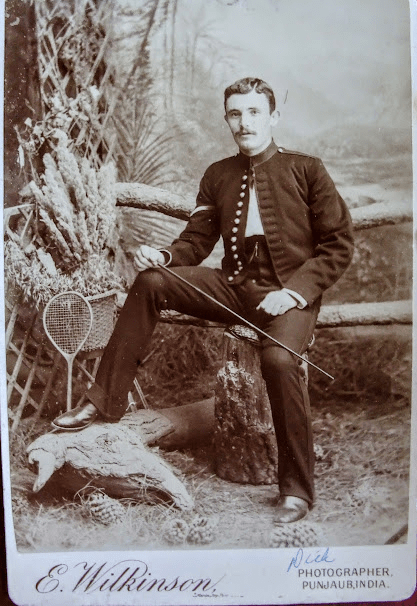
Over time, I learned a great deal about my Great Uncle Richard Edward Sleath, his wife Gwyndon Ophelia Mathias and her second husband William Frederic Perris.  I did presentations on my ancestor’s life to both the England Wales and Postscript SIGs during the winter of 2019.  To the latter, I was showing how even if you only had minimal in formation to start, it was possible to develop a story.

Since Spring 2019, the story itself has grown a life of its own and recently put me in touch with a Romanian, Liviu Bordas in Budapest, who just happened to be researching the Perris Family of Calcutta, India. I am getting ahead of myself though and must return to first telling you what I discovered about my ancestor, Richard Sleath. After that I will explain how his story morphed into a story for Relatively Speaking.   

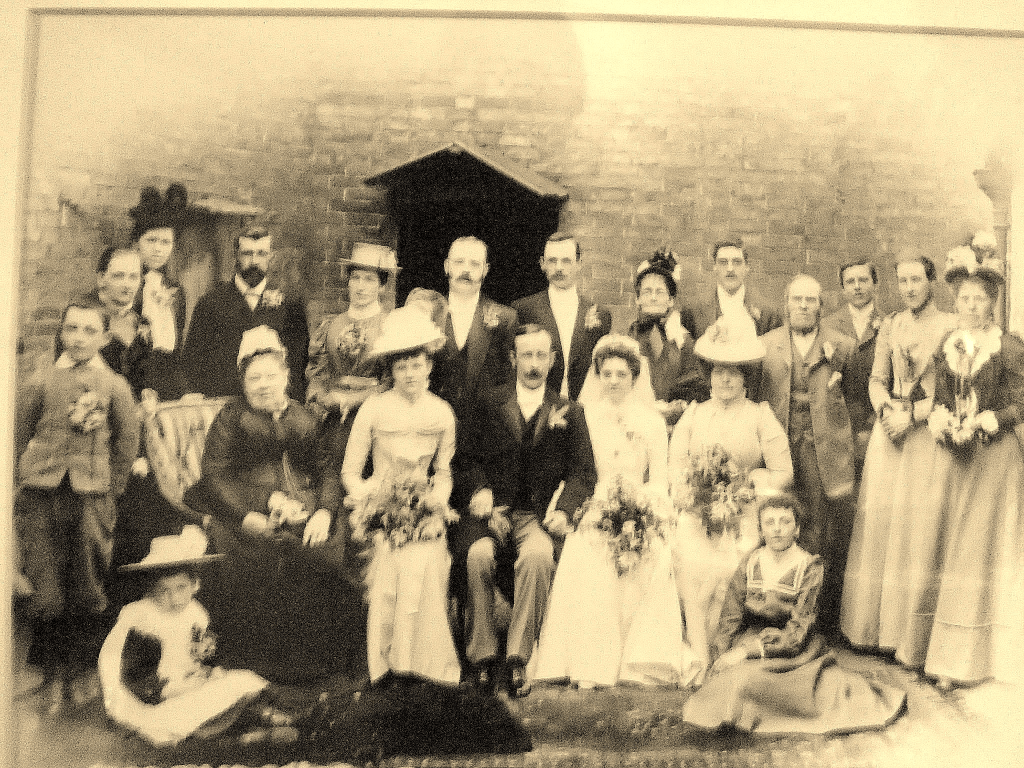
I knew my maternal grandmother, Sarah Jane Sleath, had a number of brothers and that one or more had served with the British Army. I had her 1901 wedding photo taken in Claybrooke, Leicestershire, England. The young man called Dick was not in the picture so it was possible, if indeed he was Sarah Jane’s brother, that he was stationed somewhere with the British Army in Punjab, India. 
  

I referred to a pedigree chart I had developed when I was researching the Sleath Family. Sarah Jane was born in 1869 and her brother Jack in 1866. These were the two Sleath siblings that had ended up in Alberta in the early 1900’s. There was one older brother and 4 younger brothers that remained in England.  

As I have a number of paid genealogy sites, it was natural to access them to discoverer what information they might hold. I first went to Find My Past UK and located a baptism record for Richard Edward Sleath. He was christened at St. Mary’s Parish Church in Moreton, Staffordshire on Feb 25, 1872. This document confirmed his parents were George and Abigail Sleath, the same as Sarah Jane. On the 1881 Census on Ancestry, I found the family living in Streethay, Staffordshire. This document confirmed the names and ages of all the family. It appeared that George and Jack (John) were the older brothers while Richard, Joseph and the twins, Thomas and Samuel, were the younger brothers. Sarah Jane was the only girl.   

On Ancestry I was fortunate to find Service Documents from the UK Royal Hospital, Chelsea, Pensioner Soldier Service Records 1760 – 1920. I was referred to Fold3 (owned by Ancestry) for the original documents.  These records gave me a summary of Richard’s military career.  

Summary: Richard Sleath - Military Career 

1889                –   joined the 4th Battalion Staffordshire Reg as a Militiaman​​ 

23Sept1889      -   joined King’s Royal Rifle Corp at Winchester (86267) ​​ 

08Aug1891      -   posted to Royal Horse Artillery  Dublin District formed in 1793 as distinct arm of the Royal  Regiment of  Artillery

26May1892      – appointed as a Bombardier, a military rank that has existed since the 16th century in artillery regiments various armies equivalent to the rank of corporal in other branches. 

09Sept1893      -  sent to India to fight on the NW Frontier​ 

29Sept1901  – discharged at Allahabad India ​ 

It was at this point that I had to get myself a good map of India in the 1890s plus smaller maps of the various provinces. I really had no idea where anything was and how far apart some of these places were. I also had to delve into the history of the country. It certainly wasn’t covered in my High School classes.
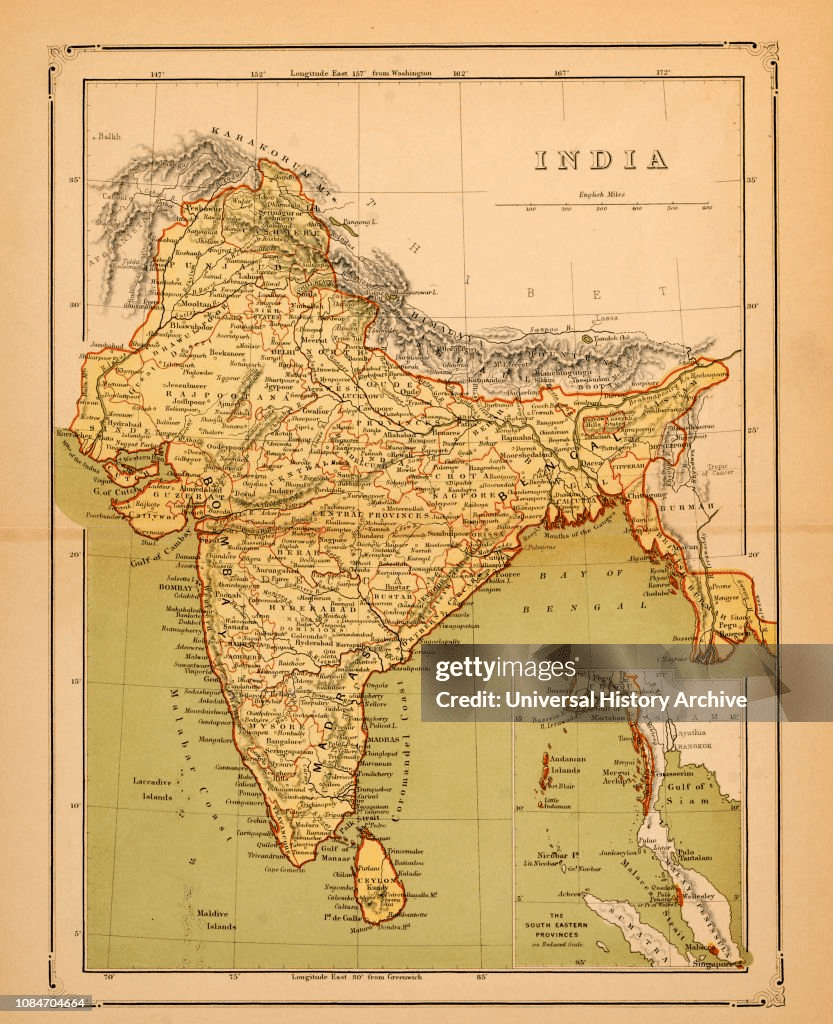
I found a book on Google called North-West Frontier 1837–1947 by  Robert Wilson Latham 

There was a summary as follows: 

“For over a hundred years British and Indian troops were engaged on the North-West Frontier of India, policing the tribes, mounting expeditions, and guarding against the ever-present threat from Russia. Populated mainly by Pathans, one of the fiercest warrior races on earth, the Frontier came to be known as “The Grim” by generations of British soldiers. It offers a rare glimpse into life on the Frontier, illuminating Lord Curzon’s remark, “No man who has read a page of Indian history will ever prophesy about the frontier”.

​I don’t know where Richard was stationed or what battles he may have been in. I do know that he was shipped to India in 1891 with the Royal Horse Artillery as a Bombardier and he was discharged at Allahabad Station in 1901.   

I created a Timeline to help in writing the story of Richard Edward Sleath​.​ 

1872    Baptized in Moreton Staffordshire​ England

1881    Living in Streethay Staffordshire​ 

1889    Militia Man in Lichfield  Stafffordshire​ 

1889    Joined Kings Royal Rifles​ 

1891    Dublin District Royal Horse Artillery Gunner​ 

1893    India  Bombardier​ (Rank between that of gunner and that of sergeant)  Royal Horse Artillery  Punjab India            

1901    Discharged at East India Railway Station​ Allahabab

       ​ 

1902    Married Gwyndon Ophelia Mathias at ​  Khagole, Bengal, India​ 

1907    Richard Sleath died 24Feb1907​ 

1908    Gwyndon Sleath (Richard’s widow) marries William Frederic Perris​ 

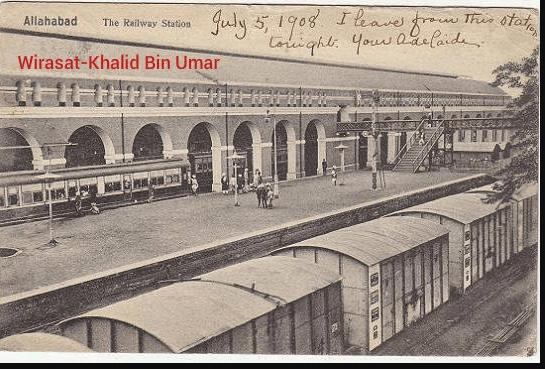
Richard was discharged from the British Army in 1901. He would have been 29 years old. As I was searching for pictures of the East India Railway Station at Allahabad on the internet I found a postcard. It had been written by Adelaide in July of 1908. She was letting someone know she was leaving from the Allahabad Station.  It struck me that this was the same station Richard would have seen. The steamer trunk held other photos including one of Richard Sleath in civilian dress. He looked older than the man in the army uniform. I guessed the photo would have been taken after he had been discharged from the army in 1901. The photographer was identified as Bourne and Shepherd of Calcutta.  I thought this picture might have been taken around the time of his wedding (1902) and one that he would send to his sister Sarah Jane.  I located an Extract from India Eagle Paper in Calcutta and learned something about this company.  
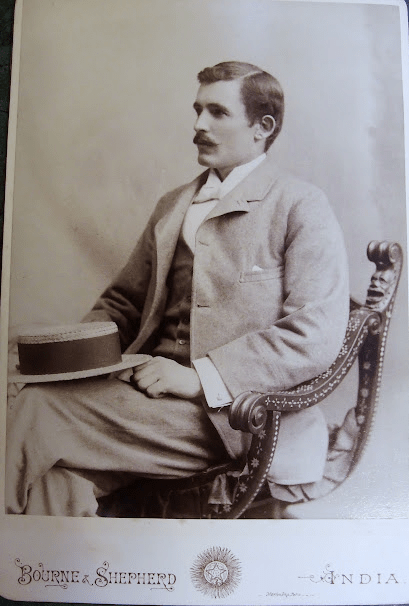
Bourne & Shepherd: World’s Oldest Operating Photo Studio in Kolkata Breathed its Last (2016) 

“This dilapidated building named ‘Photographe’ in the busiest neighborhood of Kolkata could have been converted into a world-class photography museum to preserve the footprints of India’s journey from the colonial times to the post-independence era. But Fate had something else in store for the iconic landmark where many historic events across the country were documented through photography for 176 years…..the photo studio was renamed Bourne & Shepherd in 1866  when the British photographer and traveler duo – Samuel Bourne and Charles Shepherd – took control of the business after William Howard left India.” 

 
What happened to Richard Sleath following his discharge? This was an important question I needed to answer.  I discovered a marriage registration on findmypast.co.uk. He had married a woman by the name of Gwyndon Ophelia Mathias at Christ Church, Khagole, India on September 25,1902. This record was part of the British India Office Collection . He said he was 23 and she was 17. In actuality he would have been 30. Yes our ancestors stretched the truth! 
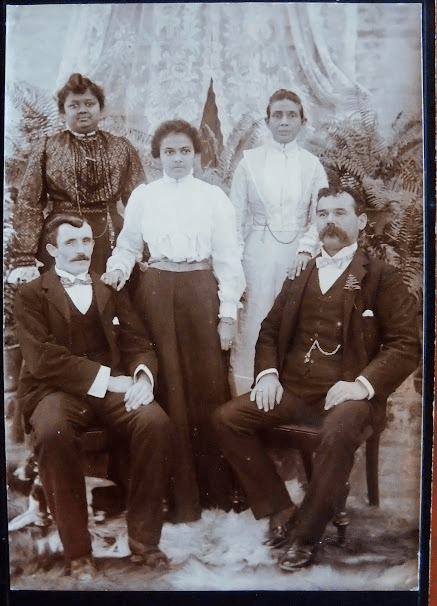
I had the wedding picture for Richard and Gwyndon. Given the style of the wedding dress this had been a very English wedding.  The couple were married for only five years when Richard died February 24, 1907 in the Medical College Hospital in Calcutta at age 35. This information was from the Times of India newspapers on the Families in British India website.  I could not find a death record. He was an employee of the East India Railway Company.

I located Richard’s will on Find My Past. It would appear that he was living a very good life in India and based on conversion rates for the rupee to today’s purchasing power in UK pounds, Gwyndon was a moderately wealthy widow. 

“I give…my household furniture, linens and wearing apparel, plates, pictures, china, horse carts and carriages and also every sum and sums of money which may be in my house…..also my stock funds and securities and all and every other money or bank notes or other securities.”

I could end my story at this point. My ancestor is deceased and he left no living children. Gwyndon, at 22 would  move on with her life. Indeed she married William Frederic Perris in 1908. 

I was curious though, as to what would happen to such a young woman. I thought why not do some additional research into Gwyndon Ophelia and her maternal family. From the family picture it was clear that her mother Ophelia was an Anglo-Indian. This woman after whom she was named came from Sylhet, Bengal in northeast India. The family name was Grose.  I found Ophelia’s father Benjamin Grose born 1840 in Sylhet and his father Robert Grose born in Calcutta in 1808. His father was John Grose but I was unable to determine where he was born.  

On the Perris side we find her husband Wiliam Frederic Perris born into a military family in Bareilly, Uttar Pradesh, India in 1879 to Corporal and Amelia Perris (2nd of the 2nd Queens). He married Gwyndon Mathias Sleath in 1908 and they had 6 children. The senior Perris’ ended up in England in 1951 following the partition of the country. 

82 Rippon Street Calcutta India

This is where the story takes a serendipitous turn. I had advertised my presentation to the Postscript group, part of the Alberta Genealogy Society on my Facebook Page. Liviu Bordas a Romanian researcher saw the post on Facebook and got in touch with John Althouse. The following morning I had a forwarded email from Liviu Bordas. Liviu had being trying to reach me since finding my blog, A Genealogist Goes Wandering, on which I had a posting about Richard and Gwyndon Sleath and William Frederic Perris. 

Liviu writes:  May 2019 

“I am doing a research on Calcutta (and generally India) during the last period of the British Raj in connection with some European scholars who visited or lived there for some time. In 2015, I have researched the India Office Records in The British Library and National Archives and found some information. I found other information, including their migration to UK, on various genealogical websites. I would like to know what you have found. Thank you.”  

Emails went back and forth. I wanted to know why he was researching the Perris Family. Turns out he was researching a noted Romanian religious scholar Mircea Eliade who had stayed with the Perris Family in their Calcutta guesthouse from 1929 to 1931. He was writing a book soon to be published and wanted permission to use some of my pictures.  

Liviu Wrote in reply to one of my emails:  “Their entire life is a great story. I wrote it. 🙂 

I put all the information I could find about them (their lives and their ancestors) in a text I wrote as introduction to Mircea Eliade’s Indian travelogue (India) and Indian diary (Șantier = Work in progress), published in 1934 and 1935 (now republished in a single volume). Eliade lived in their house for the duration of his stay in India (January 1929 – November 1931), except for January-September 1930, when he lived in the house of his professor, Surendranath Dasgupta. The Perris kept their rented home in Calcutta as a “pension” / “guest house”. In India, Eliade mentions, briefly, only Fred Perris and his brothers. But in Șantier all of them,  including Ophelia, Gwyn’s mother) are a constant presence. Isabel is modeled after Gwyndon, while Maitreyi is Maitreyi Devi, Dasguptas’s daughter. Almost all the other Perris appear under a guise in the two novels. The last one is the only one translated in English and made into a film – Bengali Nights. Eliade also kept a correspondence with the Perris family while he was traveling in India and after his return to Bucharest as well, until 1936.

The book is coming out in a week or two. I have quoted your blog post and also included one of the pictures (with Richard, Gwyn and her parents) mentioning as source the personal archive of Louise Perkins”. I apologize for doing it without securing your permission. I have tried to contact you in October and November but received no answer. Unfortunately, the publisher made the picture very small, so I think there is no much use of it in the book. The readers can go however to your blog post. I hope you won’t mind that. Let’s keep in touch. We might find other things to share. With best wishes,”  Liviu 
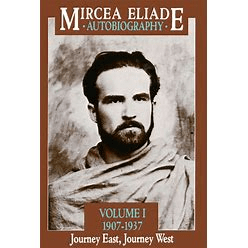
Serendipitous connections kept occurring. I found a book in a bookstore on Whyte Avenue. It contained additional information about the family and their lives when Mircea Eliade was staying there. He refers to Gwyndon Perris as Mrs. P who ran the establishment at 82 Rippon Street.. Her sons were  the same age as Mircea, all in their late teens or early 20’s. I await the publication of Liviu’s book  and translation to English. Who knows what else I might discover?  

I this story,  I discovered a further connection to a man I had never heard about until May 2019. I was taking a class and the speaker was David Goa, (Adele Goa’s brother for those of you in the know). He is a noted Religious Scholar and curated the Anno Domini Exhibit at the Royal Alberta Museum in the early 2000s. I thought I would ask him if he was familiar with Mircea Eliade. He looked at me and said “of course, he was my professor when I studied at the University of Chicago in the 60’s. He was a brilliant man!”  It is indeed a small world!

What does a picture in a trunk, a man named Mircea Eliade, a researcher in Budapest and a house at 82 Rippon Street Calcutta have in common? I have discovered that they form the basis for a very interesting story and now you know the answer. Serendipitous Connections  

Who was David Taylor McMillan?

24 Jan

I had very little information on my mother’s family when I first began to research my family history. I knew she had a brother David and a sister Daisy. They were born in Coquimbo, Chile as was my mother. They were all children of Thomas McMillan and a local woman. As these ancestors were all dead before I was born, there was no one I could question for more details. My mother was only a child when they left Chile and had few memories of her childhood by the time I got around to asking questions.

Recently I decided to see if I could find more information as it had been about 10 years since I did my first research.

I discovered that David McMillan was born in Glasgow, Scotland,not Chile, the son of Thomas McMillan and Jane Thomson, on November 30, 1879. His parents had married on June 14, 1872 at Carnmarnock near Glasgow.

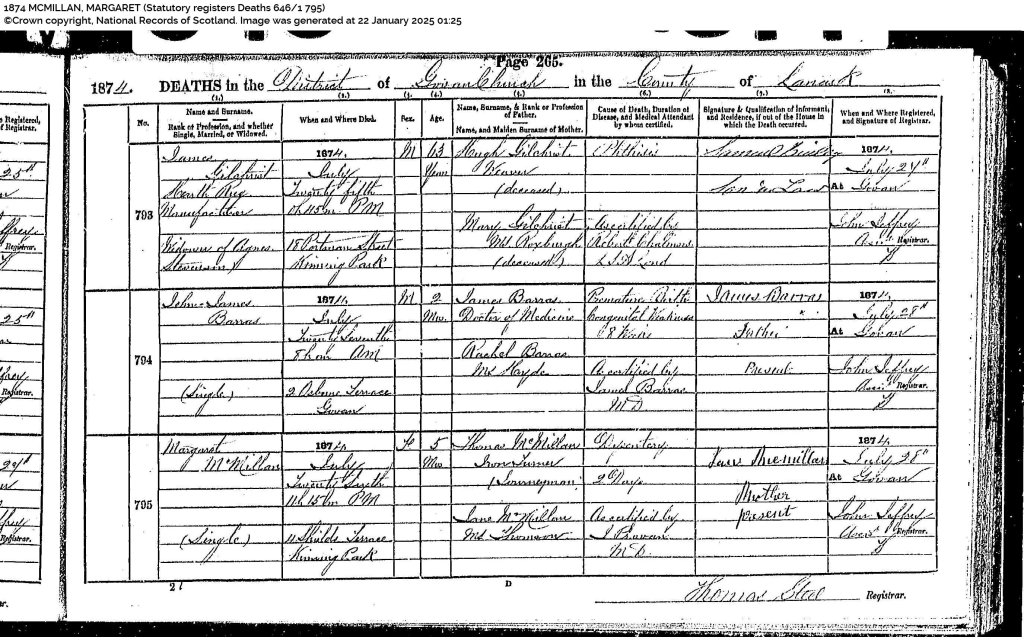
He had an older sister Margaret who was born on February 16, 1874 in Bridgeton, Glasgow Scotland. The family was living at 748 Gallowgate, Glasgow. She died on July 26, age 5 months, of dysentry and by then the family had moved and were living at 11 Shields Terrace, Kinning Park, Glasgow.

David Taylor was born on November 30, 1879 and the family had moved to 192 Claythorn Street, Glasgow.

On the 1881 Scottish census Jane and David were still living at 192 Claythorn street in Glasgow. Thomas, a steamship engineer, was likely at sea. Sometime after this the family relocates to Peru where Thomas is working for the Pacific Steamship Navigation Company on the Coastal Steamers.

Household Members (Name)AgeRelationship
Jane McMillan29Wife
David T McMillan1Son

A third child, Maria, was born December 25, 1886 in Callao, Peru but she did not survive.

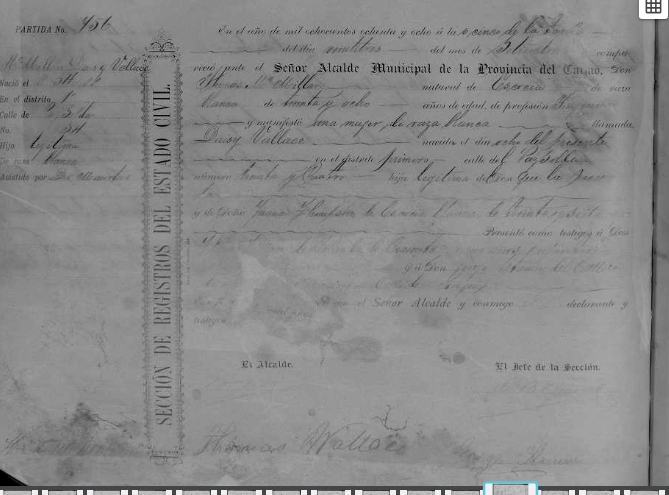
A fourth child was also born in Callao on November, 1888 . This was the woman I believed to be my aunt. Her name was Daisy Wallace McMillan.

I know little about the family’s early years in South America, as by the time my mom, Agnes Irvine McMillan was born on October 23,1908, the family was living in Coquimbo, Chile. This is where questions come in. My mother was 20 years younger than her sister Daisy. I now believe because of my DNA results, that my mom was the illegitimate daughter of Daisy. Her father is unknown but he must have been part indigenous, part Spanish. This unknown man passed on his DNA to me. I could not have had 11% Indigenous DNA from Chile/Peru/Boliva from any other source.

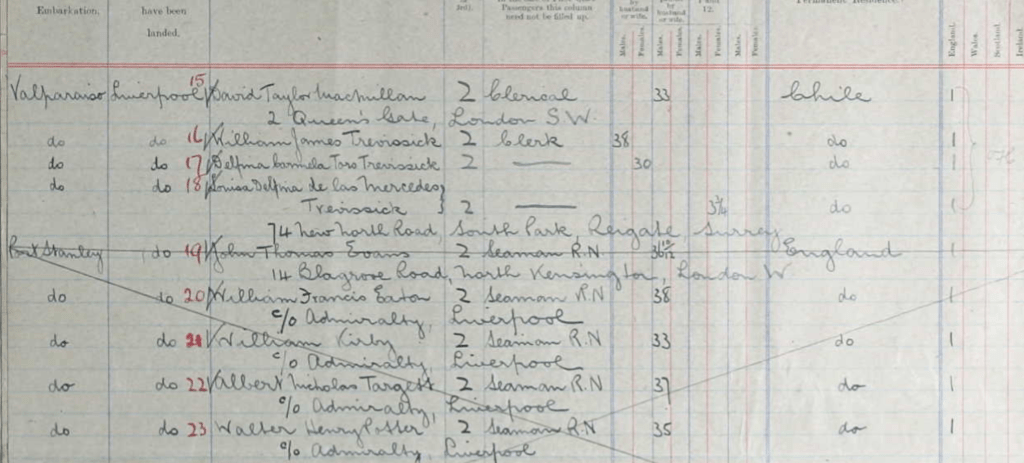
The other question was what had happened to David? My mother never spoke of him. I decided to see what I could discover about this man. David first appears on a document in 1917 when he heads to England to serve in WW1. He embarked from Valpariso, Chile destination Liverpool, England. He was 33 years old. (incorrect as he was born in 1879 and would be 37 at time of sailing in March 1917.) His address in UK was 2 Queen’s Gate, London, England. Occupation listed as clerical.

I have no information on his military service in WW1, just a photo of him in uniform.

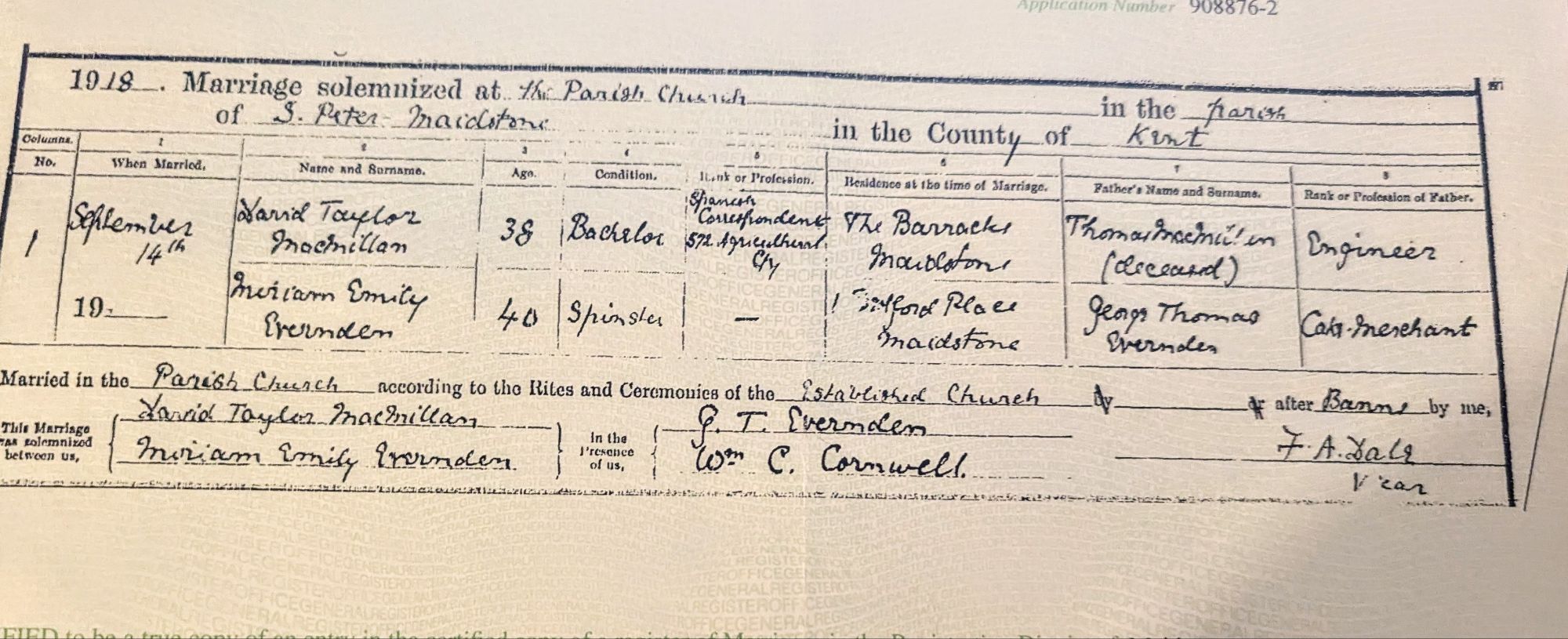
David marries Miriam Evernden, an English woman, in Maidstone, Kent on September 14, 1918.

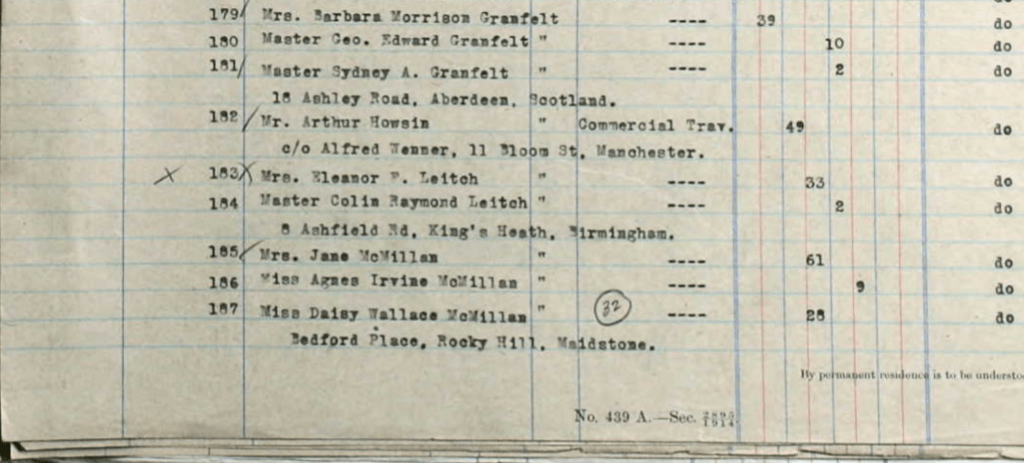
Thomas, the patriarch dies in Coquimbo in April 1919. Jane, Daisy and Agnes set sail for England. David as the only son had become responsible for the family.

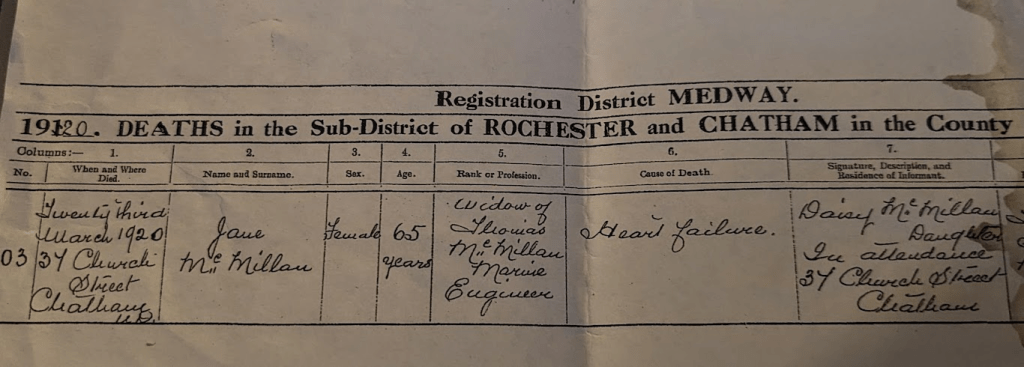
My mother remembered going to school in Maidstone. Jane McMillan, the matriarch, dies March 23, 1920 of Heart Failure. She was listed as 65 but as she was born in 1850 she would have been 70. They were living at 34 Church Street, Chatham, Kent.

Daisy marries Fred Bates, a Canadian who served in WW1, in June 1921 just before leaving for Canada.

When Daisy, her new husband Fred Bates and my mom leave England for Canada, their arrival form shows David living at Devon House, Argyle Square London, W6. This is in June 8, 1921.

The mystery deepens. I find a David MacMillan living at 66 Balcombe Street, Marylebone N W 1 on June 19, 1921 date of census. Age and birthplace is correct and he is working in a clerical job. He indicates he is marrried but is not living with his wife Miriam.


1921 England Census

NameDavid Macmillan
GenderMale
Marital StatusMarried
Age41 Years 7 Months
Relation to HeadHead
Estimated Birth Year1879
Birth PlaceGlasgow, Lancashire, England
Residence Date1921
Residence Street Address66 Balcombe Street, Marylebone N W 1
Residence PlaceSt Marylebone, London, Middlesex, England
OccupationTemp Government Clerk
Occupation Code800/6
EmployerMinistry of Labour
Employer Code719
Place of WorkKew, Surrey
Number of Children Under 160
InhabitedY
WardNo 4 Dorset Square & Regent’s Park
Parliamentary DivisionSt Marylebone Pb
Registration districtSt Marylebone
Registration District Number7
Sub registration districtNorth Marylebone
Sub Registration District Number3
RespondentMr Mac Millan
Enumeration District NameSt Marylebone Mb
Enumeration District34
Schedule344
Schedule Type CodeE
NameAge
David Macmillan41 Years 7 Month

Strangely, a further search reveals his wife Miriam back living with her parents on the 1921 census. She indicates her husband deserted her.

I searched for a death certificate for David but without success. I had all but given up when I came across a newspaper article in the Richmond Times. The name was switched around to David MacMillan Taylor. What caught my eye was the reference to a Chilean citizen. This had to be my David.

His death occurs in April 15, 1922. He would be 42, not 38. The address is 66 Balcombe Road, the same address David reported on the 1921 census. Was this an attempt to hide his whereabouts from his wife?

So the man who was born David Taylor MacMacMillan died as David MacMillan Taylor. Was this just a clerical error or was he trying to hide from his wife? Why did Miriam say her husband deserted her on the 1921 census? How long had they been living apart? They would have been married for less than 2 years. What had happened in such a short time? I guess this is something I will never know. I had wondered why David had never married in Chile. The thing that came to mind was a question. Was he gay? This was something that would be hidden in those days.

Marian, his wife died in 1960, a widow. She had money when she died. I do hope she had a good life.

Katie’s Journey: From the Russian Steppes to the Alberta Prairies

9 Mar

Knock Knock! “Hi Mrs. Brown…it’s Louise…is Judy home”? As usual Katie was in the kitchen, cleaning up after doing some baking. I had always known her to be busy, cleaning, washing, baking, cooking and preserving vegetables from her garden. No freezers in the early 1950’s. She had a cold room in the basement where the jars from her canning were stored. If she wasn’t busy around the home, she was selling Avon products in her area or was at the church for choir practice.  She loved music, sang and accompanied herself on her autoharp. In the fall, I remember fires in the Brown’s backyard after it was cleaned up and the debris burned before winter set in. Mr. Brown, aka Eric, was the fire starter.

Although I had known Katie since I was 2 years old, it was only in later years after her husband Eric had passed away in 1994,  that we became good friends. We had many conversations, some at Swiss Chalet our favorite eating place and it was during these, plus others with family members, that I learned about her remarkable life.

Katie’s family came from the villages of Grossweide and Rudnerweide, part of the Molotschna Colony of Mennonites in Russia

Katie was born into a large Mennonite family in 1921 in the small village of Grossweide, one of 57 in the Molotschna Colony just above the sea of Azov in the Russian Empire, today part of the Ukraine.  The colony of Molotschna was founded in 1804 by Mennonite settlers from West Prussia. 

“After the first Mennonite colony within the Russian Empire Chotiza was founded in 1789, Mennonite visitors found the freedoms and free land of Southern Ukraine an attractive alternative in view of restrictions placed on them in West Prussia. The imperial Russian government wanted more settlers with the valuable agricultural and craft skills of the Mennonites. In 1800 Paul l of Russia enacted a Privilegium (official privileges) for Mennonites, granting them exemption from military service “for all time”. In West Prussia King Frederick William lll was making it difficult for Mennonites to acquire land, because of their refusal to serve in the military due to their pacifist religious beliefs. Another reason to immigrate was fear of the changes brought about by the French Revolution. Refuge in Russia was seen as a more secure alternative.

The first settlers, 162 families, emigrated in 1803 to the existing Chortitza settlement and spent the winter there. They founded the first 9 new villages near the Molochna River in 1804. The central Russian government set aside a 1,200 km (297,000 acres) tract of land for the settlers along the Molochna River in the Taurida Goverate. The next year an additional group of about the same size arrived and they formed an additional 9 villages. Each family received 0.7 km (170 acres) of land. In contrast to the settlement of Chortitza, wealthy Mennonites also immigrated to Molotschna. They sold their farms in Germany, paid a 10% emigration tax, and brought the remainder into the Russian Empire. Arriving with superior farming skills and more wealth, they developed new farms and businesses more easily than had been the case for early settlers in Chortitza. The seaport city of Taganrog provided a convenient market for their dairy products in the early years. Wheat later became the predominant commodity crop. By 1840, there were 44 villages in this area and immigrants were no longer accepted for settlement in the Molotschna.”  (Wikipedia)

Index to the 1835 Molotschna Census     Compiled by Richard D. Thiessen
Wall, Abram Abram (b. ca.1795) : Grossweide 1

Each village had an elementary school. At a time when compulsory education was unknown in Europe, the students were taught reading and writing (Mennonite Plaudiestch dialect – low German), arithmetic, religion and singing. The teacher was typically a craftsperson or herder, untrained in teaching, who fit class time around his main work.    I understood Katie had only the equivalent of grade 6 education, but  she was a smart woman. After her husband Eric passed away in 1994, she kept all her household accounts in a book. She would record when all her bills were paid, how much things cost. In 1992 when she and Eric sold the family home, she was the person that handled most of the real estate dealings to purchase the new condo. Katie also loved to crochet and all her family has at least one afghan by which to remember her.

Times were tough in Russia in 1920, there was little food and many families had already left for North and South America. The Mennonite villages felt the full impact of the famine and the preceding drought. If the people were lucky they might find an onion or a few beet greens, if not then their diet was reduced to moss, chaff, dried weeds and ground corn cobs. Katie’s father Herman Wall was a teacher in the village. He and his wife Katerina had a large family…5 boys and 7 girls. Katie had been sickly as a young child and inadequate food didn’t help a growing girl. The Mennonites of Molotschna sent a commission to North America in the summer of 1920 to alert American Mennonites of the dire conditions of war-torn Ukraine.  A year passed before the Soviet government gave official permission for the International Mennonites to conduct relief work among the villages of Ukraine. Kitchens provided 25,000 people a day with rations over a period of three years beginning in 1922, with a peak of 40,000 servings during August of that year.

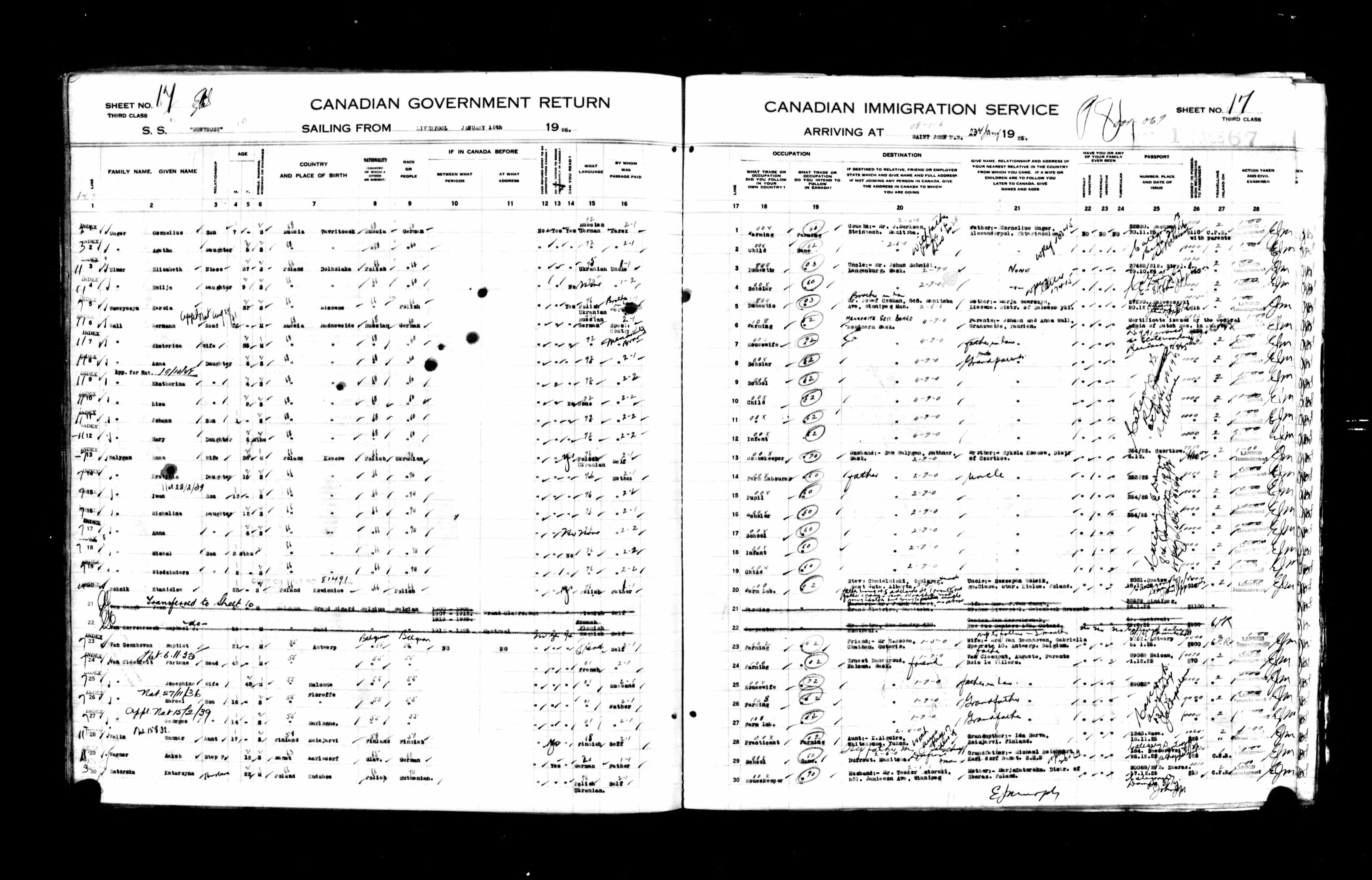
Canada, Incoming Passenger Lists, 1865-1935 for Hermann Wall   Ancestry.co.uk

Hermann 36, Katherina 35, Anna 6, Katherina 4, Lisa 2, Johann 1+ and Mary 6 mo. Departed Liverpool England for St. John New Brunswick arriving 25Jan1926    ancestry.co.uk    

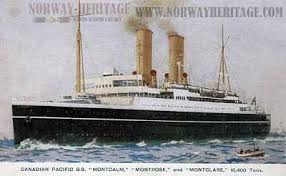
In 1925 it was the Wall Family’s turn to leave. They would take a train across the country to a European port . There they would board a ship that would take them to Liverpool, England. They were held up in quarantine in England for several months before before sailing to Canada. They sailed aboard the Montrose and arrived in on Jan 25, 1926 at the port in St. John New Brunswick.

Waiting to board the train to leave Russia.

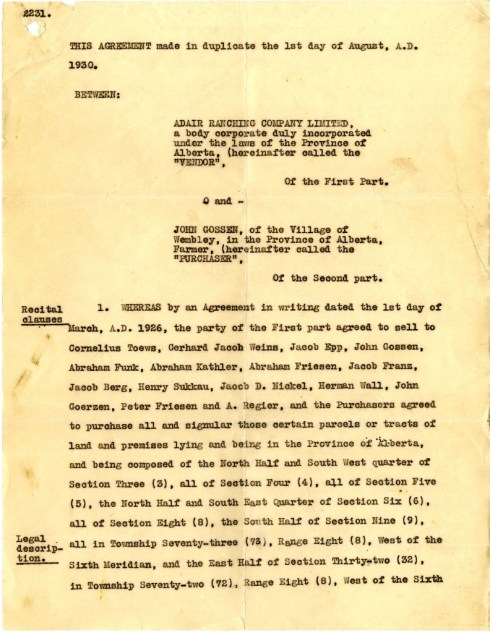
They then had a long train journey  across Canada  from New Brunswick  to Edmonton, Alberta and then on to Wembly where there were to live. How they made that last part of the journey I do not know.  I found this document online (South Peace Archives) and see that it wasn’t long before this industrious group of people were purchasing land for their settlement at Wembley.

Johann J. Gossen fonds, 1930, April 5, 2018 2:19 pm Accession 2011.011 Administrative/Biographical History  South Peace Archives
“Johann Gossen was born 1 January 1879 at Landskrone, Molotschna, Taurida, South Russia.  He was the son of Jakob Johann Gossen and Sara Berg and married Helena Friesen on 27 June 1910.  He was a school teacher by profession but also worked as a jeweller and mechanic. During World War I he served as a marine mechanic in the Russian navy.  He immigrated to Canada in 1923, living first at Swalwell, Alberta, before moving to Wembley, Alberta in 1929.  There he represented a group of 15 families who purchased and then subdivided the land and assets of the Adair Ranch.  This ranch which in 1926 consisted of  22 quarter sections of land, a large barn for 100 horses, 2 houses, a blacksmith shop and a pump house, had been purchased in 1926 by a group of Russian Mennonite immigrants.  The immigrants included members of both Mennonite and Mennonite Brethren churches worshipped together on the ranch as members or participants in the Hoffnungsfelder Mennonite Church.   They also worked the land together for two years, but in 1929 the Mennonite Brethren built their own church and a decision was made to sub-divide the land.  Some of the original settlers left and others, including Johann Gossen, negotiated a new agreement in 1930.  In those negotiations Johann Gossen, acted on behalf of the purchasing group.  The original copy of this agreement is held in the Regional Archives in Grande Prairie, Alberta. The Gossen family moved from Wembley to Burns Lake, British Columbia in 1932 where Johann Gossen died on 23 April 1945.”
 

John Gossen represented the families in the purchase of the land from the Adair Ranch Company. Name Herman Wall (Katie’s Father) is listed.


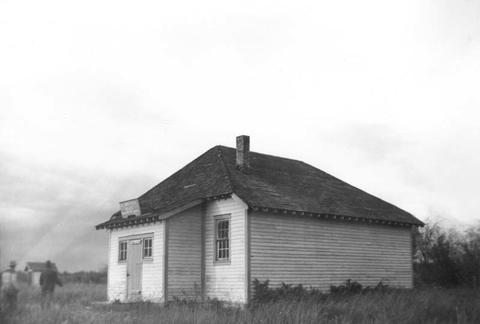
Big Horn School
\


Katie started her Canadian schooling at the Bighorn School  and then moved on to the Meadowville  School for another 5 years. In her teens she got a job at Bear Lake and then a house maid job in Sexsmith. This was the home of Florence May (Dillon) and Donald Park Brown. It was here that she met her future husband Eric Brown, They were married August 8, 1941. They moved to Edmonton where they would live for the rest of their lives. They were blessed with 3 daughters, Verna, Shirley and Judy, in the following years. After several moves, they settled in the house on 69 avenue where they were to remain until 1992
when they downsized to a condo in the west end.
 

Katie and Eric in Sexsmith, Alberta


Young Katie at 20 years of age


Always a smile


Wedding Day


Katie and Eric were lifetime members of the Alliance Church and it was a central part of their lives. I went with Judy to the youth activities at the Richmond Alliance Church. Progressive Suppers were one of my favorite activities along with hay rides at a farm near the city. Oh did I forget to mention..we found the boys that attended Youth Group most interesting!
    
 
 Given that Eric was 21 years older than Katie, it was necessary for her to learn to drive when she was 68   as Eric could no longer handle that task. They were   able to make a trip to Grand Prairie and Jasper with   Katie at the wheel.
 

Eric and his mother Lizzie with the girls


Katie and her family …Eric, Verna, Judy and Shirley

Eric looking so proud of his family in this studio photograph. (1948)

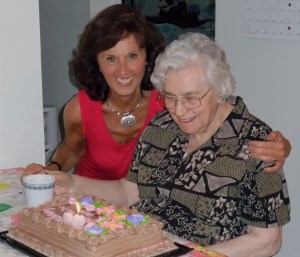
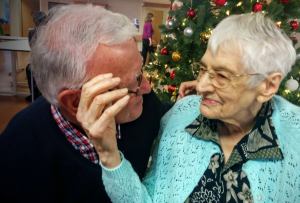
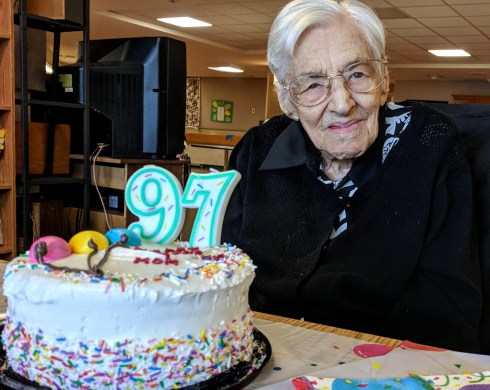
Katie spent the latter years of her life in her west end condo, followed by several years at Lifestyle’s Terra Losa. She celebrated many birthdays at these places.

2011-07-05 17.16.17

Judy (daughter) and Katie


My Favorite man….Brian Thom


Scott (grandson),Shirley (daughter) and Katie at dinner at Swiss Chalet

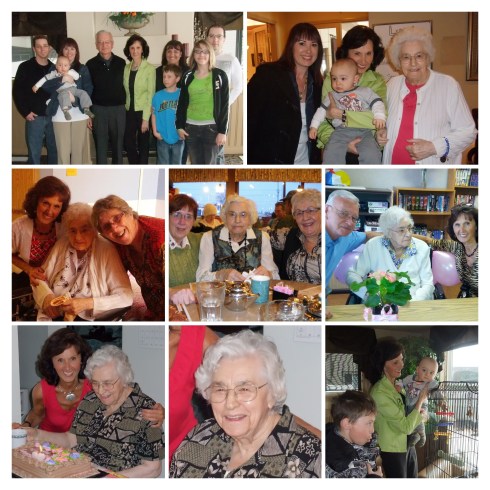
Gatherings over time….Top Left..Patrick, Kim and Ty Jackson, Brian and Judy Thom, Keri Lee and Chris Miller and Cody and Angelica, Top Right..Kim, Judy Ty and Katie; Center..Judy Katie Louise, Louise, Katie Verna, Brian, Katie and Judy; Bottom…Judy Katie, Katie, Cody, Judy Ty                                                               

Her final years were spent at the Edmonton General Continuing Care Center. Katie was an ordinary woman who lived an extraordinary life. She will be missed.

Katie and her sister Margaret at 98th birthday party July 5, 2019

On January 30, 2020, Katie Brown, of Edmonton, passed away peacefully into the presence of her Lord at the age of 98 years. Predeceased in 1994 by her loving husband, Eric, after 53 years of marriage. She will be lovingly remembered by her three daughters, Verna, Shirley, and Judy (Brian); seven grandchildren, thirteen great-grandchildren, four great-great-grandchildren, two remaining sisters, Margaret and Lena; and many other relatives and friends. Funeral Service will be held on Saturday, February 8, 2020 at 11:00 a.m. at Beulah Alliance Church, 17504 98A Ave NW, Edmonton.

Katie’s Family Tree

Mother Katerina Nickel B. Dec 6, 1890 Streifeld, Russia Died Jan 8, 1975 age 84

Baptized May 18, 1909 by her father Rev. Dave Nickel

Father Hermann Wall B. Aug 15, 1889 Rudnerweide, Russia

Baptized 1910 by his father-in-law Rev. Dave Nickel

Married Dec 27, 1916 in Grossweide, Russia Rev. Johann Wiens was the minister

They lived in Grossweide till Sept 3, 1925 when they left for Canada. Were delayed 3 months in England with a sick child. They arrived Jan 29, 1926.

Children born in Russia

David                      14Apr1918 deceased

Anna                       11Mar1919                        died Wembley AB 19Apr1953

David                      14Mar1920 deceased

Katerina                  5Jul1921 Grossweide          died Jan 29, 2020

Elizabeth                 9Sep1922 

Johann                    2Jan 1924

Mariechan             16Apr1925 

Margaret               19Apr1927 Bear Lake at home

Lena                      19Jun1928 Wembley at home

Aganeta                13Jan1931 Grande Prairie Hospital

Peter                     11Sep1932 GP Hospital deceased

Heinrich                12 June1937 GP Hospital

Katie’s Nickel Family  Maternal line

Mother Katherina Nickel                                   Born 06Dec1890  Steifeld, Russia

Grandfather David Nickel  Mennonite Pastor  Born 17Aug1853 Rudnerweide Russia  Died 21Aug1940  Chortitza Russia

Grandmother Margareta Nickel (Dueck)         Born 04Feb1856 Pordenau Russia       Died 30Nov1915  Grosweide, Russia

Great Grandfather David Nickel                       Born 07Aug1808   Rudnerweide Stumischen Niederung West Prussia  

                                                                        Moved 1878 Mountain Lake Minnesota USA  Died 1882

Great Grandmother Helena Janzen                Born  13Jun1813   Schenmesser settlement      Died  2Feb 1895 age 81                                                                                Mountain Lake Minnesota

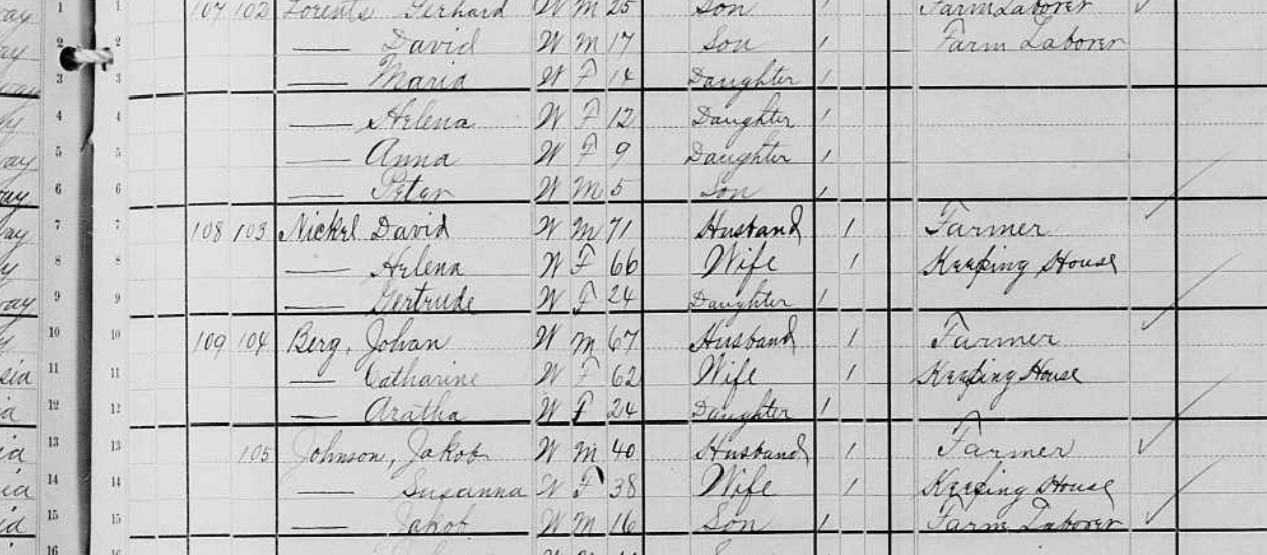
1880 Census Mountain Lake, Minn

David Nickel

Great Great Grandfather       Abraham Nickel             Born 03Nov1772  West Prussia    Island Kuecke  Died age 65 1837

Great Great Grandmother     Sara Unrah                     Born 1775 – 1809

Great Great Great Great Grandfather  Siebrandt Nickel   Born 21Sep1745  Prussia Stumschen Niederung

Great Great Great Grandmother         Maria Tgart   Born 03Apr1754  Tragheimweide   Died11Apr1802

Mennonite immigration and influence Mountain Lake Minnesota

The coming of the railroad in 1873 played a big role in the expansion of the village. By the time Mountain Lake was formally incorporated in 1886, it had a population of three hundred people, primarily composed of Mennonites immigrating from southern Russia (present-day Ukraine).

In 1873, Mennonite immigrants from the Ukraine (at that time, Ukraine was part of the Russian Empire) began to arrive in Mountain Lake, having been recruited by William Seeger, a member of the Minnesota State Board of Immigration. Seeger had the majority of these Mennonite families come from the Molotschna Colony, located near the present-day city of Melitopol, Ukraine. However, a number of Manitoba Mennonites originally from the Chortitza Colony, near the present-day Ukrainian city of Zaporizhzhia, also settled in the Mountain Lake area. By 1880, it is estimated that some 295 Mennonite families had settled there

Because Mountain Lake was already an established community and its surrounding farmland largely surveyed, the Mennonites could not arrange themselves in the traditional communal villages they had been accustomed to in their Ukrainian colonies. This forced them to adapt to American-style, single family farms and to live amongst their non-Mennonite neighbors. As settlement continued, the Mennonites of Mountain Lake had soon established a successful and cohesive community, “based primarily on agriculture and local commerce.” For many decades thereafter, they retained the speaking of Plautdietsch, the Mennonite variation of Low German.

On October 14, 1889, the Konference der Vereinigten Mennoniten-Brueder von Nord America was founded in Mountain Lake. Elder Aaron Wall, founder of the Bruderthaler Church of Mountain Lake and Elder Isaac Peters of the Ebenezer Church of Henderson, Nebraska were instrumental in the establishment of this new Mennonite denomination. Known today as the Fellowship of Evangelical Bible Churches (FEBC), for many years the conference was popularly called the Bruderthaler Conference because of the influential nature of the Mountain Lake founding church. In 1914 the name was officially changed to The Defenceless Mennonite Brethren in Christ of North America. The name was changed once again, in 1937, to Evangelical Mennonite Brethren (EMB). The denominational headquarters was located in Mountain Lake until 1956.