
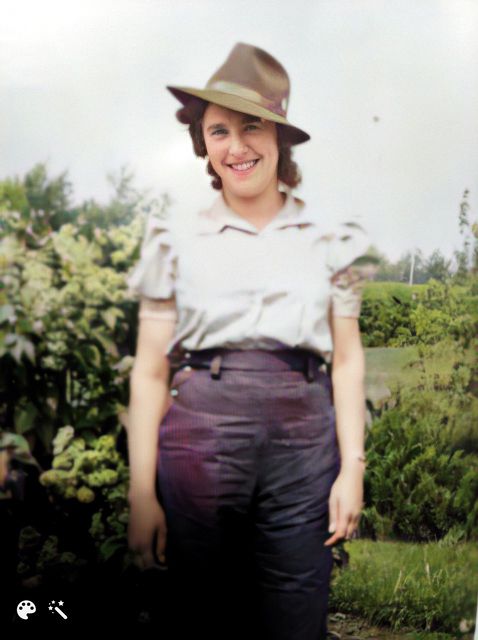
Knock Knock! “Hi Mrs. Brown…it’s Louise…is Judy home”? As usual Katie was in the kitchen, cleaning up after doing some baking. I had always known her to be busy, cleaning, washing, baking, cooking and preserving vegetables from her garden. No freezers in the early 1950’s. She had a cold room in the basement where the jars from her canning were stored. If she wasn’t busy around the home, she was selling Avon products in her area or was at the church for choir practice. She loved music, sang and accompanied herself on her autoharp. In the fall, I remember fires in the Brown’s backyard after it was cleaned up and the debris burned before winter set in. Mr. Brown, aka Eric, was the fire starter.
Although I had known Katie since I was 2 years old, it was only in later years after her husband Eric had passed away in 1994, that we became good friends. We had many conversations, some at Swiss Chalet our favorite eating place and it was during these, plus others with family members, that I learned about her remarkable life.

Katie’s family came from the villages of Grossweide and Rudnerweide, part of the Molotschna Colony of Mennonites in Russia
Katie was born into a large Mennonite family in 1921 in the small village of Grossweide, one of 57 in the Molotschna Colony just above the sea of Azov in the Russian Empire, today part of the Ukraine. The colony of Molotschna was founded in 1804 by Mennonite settlers from West Prussia.
“After the first Mennonite colony within the Russian Empire Chotiza was founded in 1789, Mennonite visitors found the freedoms and free land of Southern Ukraine an attractive alternative in view of restrictions placed on them in West Prussia. The imperial Russian government wanted more settlers with the valuable agricultural and craft skills of the Mennonites. In 1800 Paul l of Russia enacted a Privilegium (official privileges) for Mennonites, granting them exemption from military service “for all time”. In West Prussia King Frederick William lll was making it difficult for Mennonites to acquire land, because of their refusal to serve in the military due to their pacifist religious beliefs. Another reason to immigrate was fear of the changes brought about by the French Revolution. Refuge in Russia was seen as a more secure alternative.
The first settlers, 162 families, emigrated in 1803 to the existing Chortitza settlement and spent the winter there. They founded the first 9 new villages near the Molochna River in 1804. The central Russian government set aside a 1,200 km (297,000 acres) tract of land for the settlers along the Molochna River in the Taurida Goverate. The next year an additional group of about the same size arrived and they formed an additional 9 villages. Each family received 0.7 km (170 acres) of land. In contrast to the settlement of Chortitza, wealthy Mennonites also immigrated to Molotschna. They sold their farms in Germany, paid a 10% emigration tax, and brought the remainder into the Russian Empire. Arriving with superior farming skills and more wealth, they developed new farms and businesses more easily than had been the case for early settlers in Chortitza. The seaport city of Taganrog provided a convenient market for their dairy products in the early years. Wheat later became the predominant commodity crop. By 1840, there were 44 villages in this area and immigrants were no longer accepted for settlement in the Molotschna.” (Wikipedia)
Index to the 1835 Molotschna Census Compiled by Richard D. Thiessen
Wall, Abram Abram (b. ca.1795) : Grossweide 1
Each village had an elementary school. At a time when compulsory education was unknown in Europe, the students were taught reading and writing (Mennonite Plaudiestch dialect – low German), arithmetic, religion and singing. The teacher was typically a craftsperson or herder, untrained in teaching, who fit class time around his main work. I understood Katie had only the equivalent of grade 6 education, but she was a smart woman. After her husband Eric passed away in 1994, she kept all her household accounts in a book. She would record when all her bills were paid, how much things cost. In 1992 when she and Eric sold the family home, she was the person that handled most of the real estate dealings to purchase the new condo. Katie also loved to crochet and all her family has at least one afghan by which to remember her.
Times were tough in Russia in 1920, there was little food and many families had already left for North and South America. The Mennonite villages felt the full impact of the famine and the preceding drought. If the people were lucky they might find an onion or a few beet greens, if not then their diet was reduced to moss, chaff, dried weeds and ground corn cobs. Katie’s father Herman Wall was a teacher in the village. He and his wife Katerina had a large family…5 boys and 7 girls. Katie had been sickly as a young child and inadequate food didn’t help a growing girl. The Mennonites of Molotschna sent a commission to North America in the summer of 1920 to alert American Mennonites of the dire conditions of war-torn Ukraine. A year passed before the Soviet government gave official permission for the International Mennonites to conduct relief work among the villages of Ukraine. Kitchens provided 25,000 people a day with rations over a period of three years beginning in 1922, with a peak of 40,000 servings during August of that year.
Canada, Incoming Passenger Lists, 1865-1935 for Hermann Wall Ancestry.co.uk
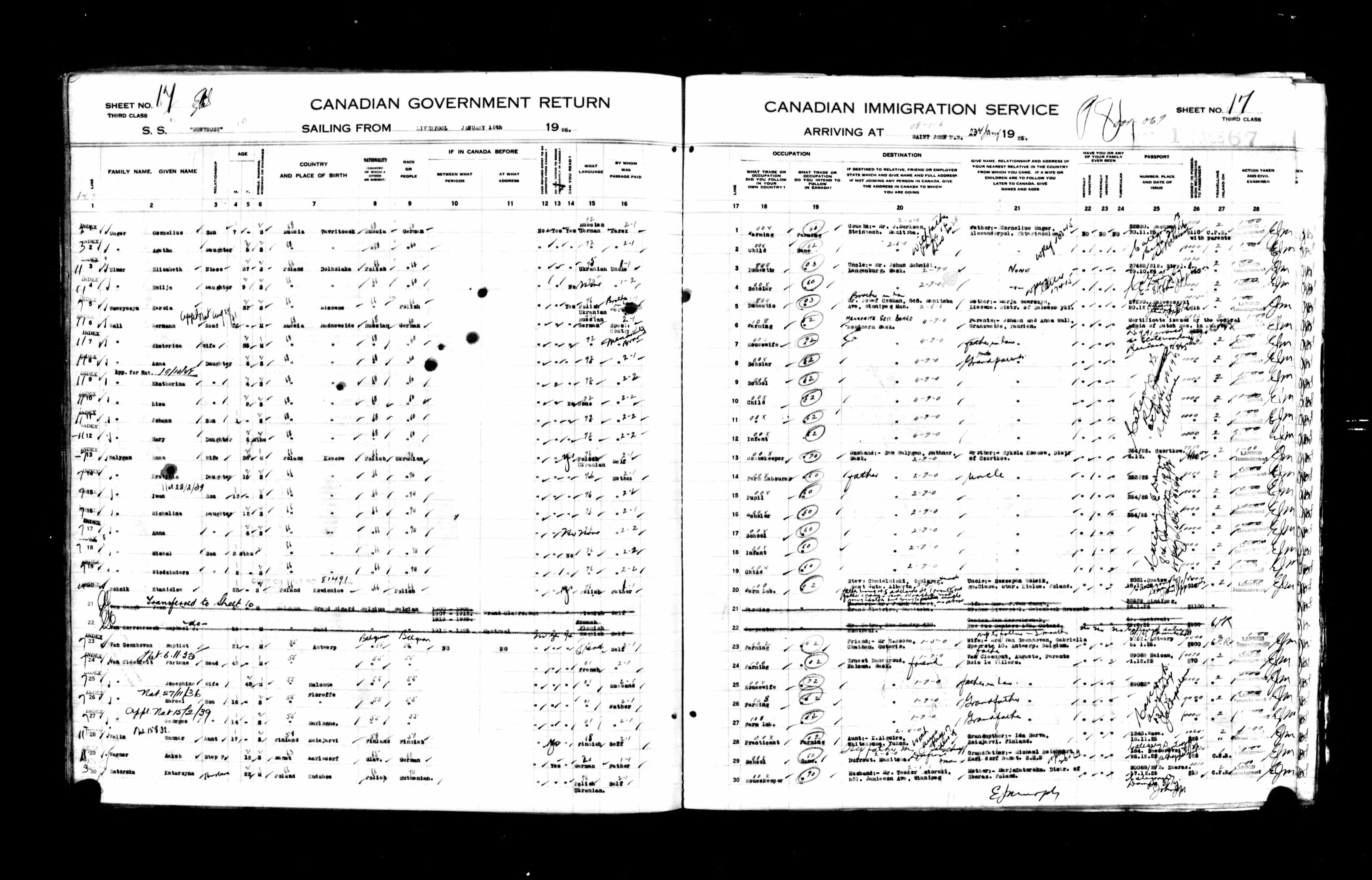 Hermann 36, Katherina 35, Anna 6, Katherina 4, Lisa 2, Johann 1+ and Mary 6 mo. Departed Liverpool England for St. John New Brunswick arriving 25Jan1926 ancestry.co.uk
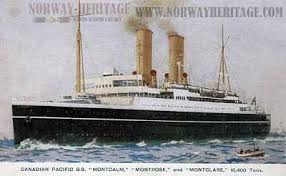
In 1925 it was the Wall Family’s turn to leave. They would take a train across the country to a European port . There they would board a ship that would take them to Liverpool, England. They were held up in quarantine in England for several months before before sailing to Canada. They sailed aboard the Montrose and arrived in on Jan 25, 1926 at the port in St. John New Brunswick.

Waiting to board the train to leave Russia.
They then had a long train journey across Canada from New Brunswick to Edmonton, Alberta and then on to Wembly where there were to live. How they made that last part of the journey I do not know. I found this document online (South Peace Archives) and see that it wasn’t long before this industrious group of people were purchasing land for their settlement at Wembley.
Johann J. Gossen fonds, 1930, April 5, 2018 2:19 pm Accession 2011.011 Administrative/Biographical History South Peace Archives
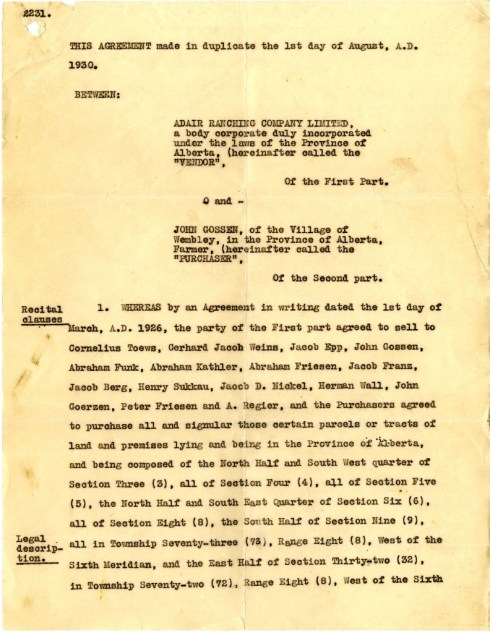
John Gossen represented the families in the purchase of the land from the Adair Ranch Company. Name Herman Wall (Katie’s Father) is listed.
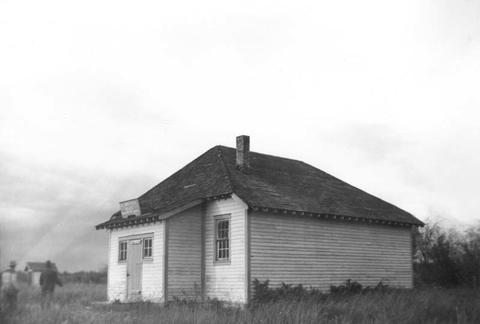
Big Horn School
\
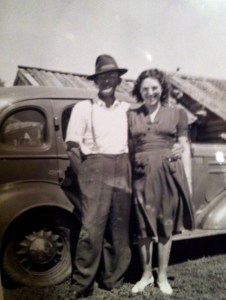
Katie and Eric in Sexsmith, Alberta
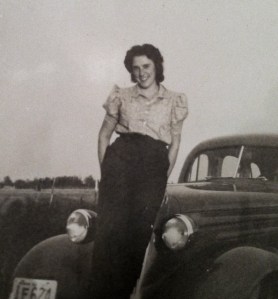
Young Katie at 20 years of age
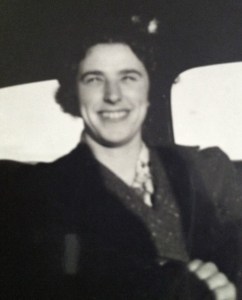
Always a smile
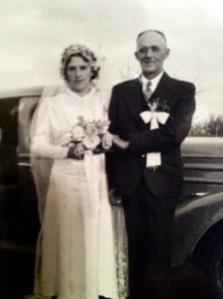
Wedding Day


Eric and his mother Lizzie with the girls

Katie and her family …Eric, Verna, Judy and Shirley

Eric looking so proud of his family in this studio photograph. (1948)
Katie spent the latter years of her life in her west end condo, followed by several years at Lifestyle’s Terra Losa. She celebrated many birthdays at these places.
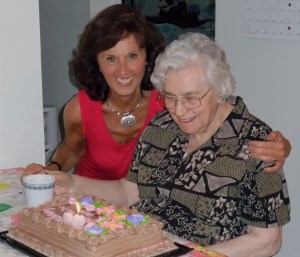
Judy (daughter) and Katie
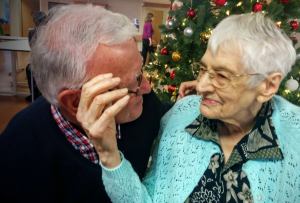
My Favorite man….Brian Thom

Scott (grandson),Shirley (daughter) and Katie at dinner at Swiss Chalet
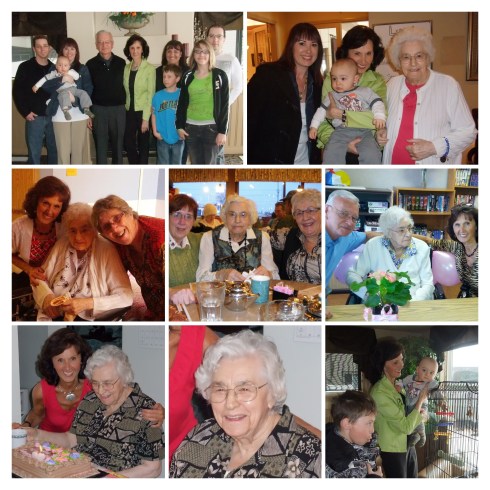
Gatherings over time….Top Left..Patrick, Kim and Ty Jackson, Brian and Judy Thom, Keri Lee and Chris Miller and Cody and Angelica, Top Right..Kim, Judy Ty and Katie; Center..Judy Katie Louise, Louise, Katie Verna, Brian, Katie and Judy; Bottom…Judy Katie, Katie, Cody, Judy Ty
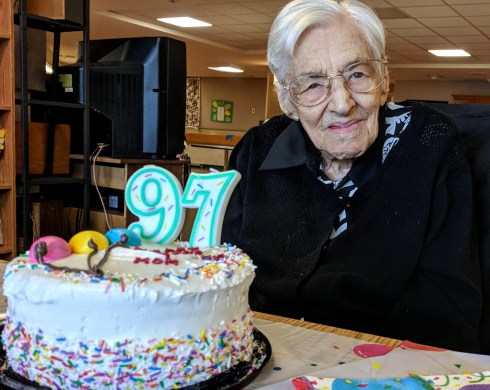
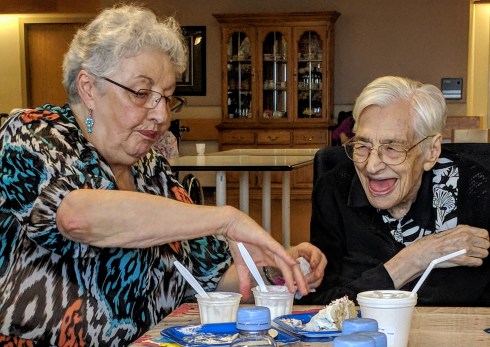
Her final years were spent at the Edmonton General Continuing Care Center. Katie was an ordinary woman who lived an extraordinary life. She will be missed.

Katie and her sister Margaret at 98th birthday party July 5, 2019
On January 30, 2020, Katie Brown, of Edmonton, passed away peacefully into the presence of her Lord at the age of 98 years. Predeceased in 1994 by her loving husband, Eric, after 53 years of marriage. She will be lovingly remembered by her three daughters, Verna, Shirley, and Judy (Brian); seven grandchildren, thirteen great-grandchildren, four great-great-grandchildren, two remaining sisters, Margaret and Lena; and many other relatives and friends. Funeral Service will be held on Saturday, February 8, 2020 at 11:00 a.m. at Beulah Alliance Church, 17504 98A Ave NW, Edmonton.
Katie’s Family Tree
Mother Katerina Nickel B. Dec 6, 1890 Streifeld, Russia Died Jan 8, 1975 age 84
Baptized May 18, 1909 by her father Rev. Dave Nickel
Father Hermann Wall B. Aug 15, 1889 Rudnerweide, Russia
Baptized 1910 by his father-in-law Rev. Dave Nickel
Married Dec 27, 1916 in Grossweide, Russia Rev. Johann Wiens was the minister
They lived in Grossweide till Sept 3, 1925 when they left for Canada. Were delayed 3 months in England with a sick child. They arrived Jan 29, 1926.
Children born in Russia
David 14Apr1918 deceased
Anna 11Mar1919 died Wembley AB 19Apr1953
David 14Mar1920 deceased
Katerina 5Jul1921 Grossweide died Jan 29, 2020
Elizabeth 9Sep1922
Johann 2Jan 1924
Mariechan 16Apr1925
Margaret 19Apr1927 Bear Lake at home
Lena 19Jun1928 Wembley at home
Aganeta 13Jan1931 Grande Prairie Hospital
Peter 11Sep1932 GP Hospital deceased
Heinrich 12 June1937 GP Hospital
Katie’s Nickel Family Maternal line
Mother Katherina Nickel Born 06Dec1890 Steifeld, Russia
Grandfather David Nickel Mennonite Pastor Born 17Aug1853 Rudnerweide Russia Died 21Aug1940 Chortitza Russia
Grandmother Margareta Nickel (Dueck) Born 04Feb1856 Pordenau Russia Died 30Nov1915 Grosweide, Russia
Great Grandfather David Nickel Born 07Aug1808 Rudnerweide Stumischen Niederung West Prussia
Moved 1878 Mountain Lake Minnesota USA Died 1882
Great Grandmother Helena Janzen Born 13Jun1813 Schenmesser settlement Died 2Feb 1895 age 81 Mountain Lake Minnesota
1880 Census Mountain Lake, Minn
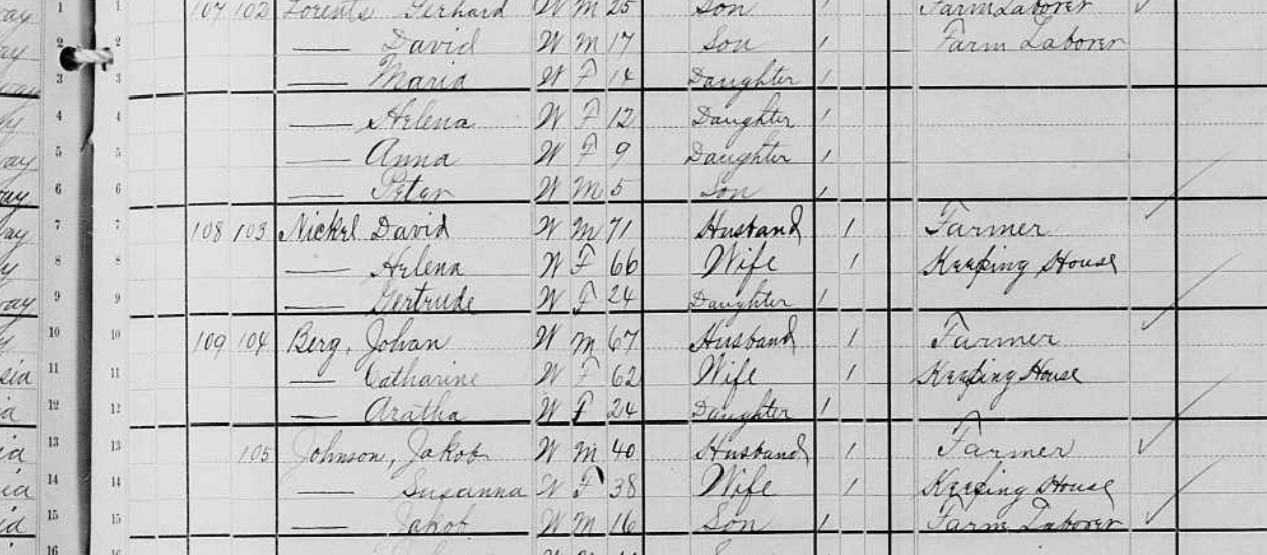
Great Great Grandfather Abraham Nickel Born 03Nov1772 West Prussia Island Kuecke Died age 65 1837
Great Great Grandmother Sara Unrah Born 1775 – 1809
Great Great Great Great Grandfather Siebrandt Nickel Born 21Sep1745 Prussia Stumschen Niederung
Great Great Great Grandmother Maria Tgart Born 03Apr1754 Tragheimweide Died11Apr1802
Mennonite immigration and influence Mountain Lake Minnesota
The coming of the railroad in 1873 played a big role in the expansion of the village. By the time Mountain Lake was formally incorporated in 1886, it had a population of three hundred people, primarily composed of Mennonites immigrating from southern Russia (present-day Ukraine).
In 1873, Mennonite immigrants from the Ukraine (at that time, Ukraine was part of the Russian Empire) began to arrive in Mountain Lake, having been recruited by William Seeger, a member of the Minnesota State Board of Immigration. Seeger had the majority of these Mennonite families come from the Molotschna Colony, located near the present-day city of Melitopol, Ukraine. However, a number of Manitoba Mennonites originally from the Chortitza Colony, near the present-day Ukrainian city of Zaporizhzhia, also settled in the Mountain Lake area. By 1880, it is estimated that some 295 Mennonite families had settled there
Because Mountain Lake was already an established community and its surrounding farmland largely surveyed, the Mennonites could not arrange themselves in the traditional communal villages they had been accustomed to in their Ukrainian colonies. This forced them to adapt to American-style, single family farms and to live amongst their non-Mennonite neighbors. As settlement continued, the Mennonites of Mountain Lake had soon established a successful and cohesive community, “based primarily on agriculture and local commerce.” For many decades thereafter, they retained the speaking of Plautdietsch, the Mennonite variation of Low German.
On October 14, 1889, the Konference der Vereinigten Mennoniten-Brueder von Nord America was founded in Mountain Lake. Elder Aaron Wall, founder of the Bruderthaler Church of Mountain Lake and Elder Isaac Peters of the Ebenezer Church of Henderson, Nebraska were instrumental in the establishment of this new Mennonite denomination. Known today as the Fellowship of Evangelical Bible Churches (FEBC), for many years the conference was popularly called the Bruderthaler Conference because of the influential nature of the Mountain Lake founding church. In 1914 the name was officially changed to The Defenceless Mennonite Brethren in Christ of North America. The name was changed once again, in 1937, to Evangelical Mennonite Brethren (EMB). The denominational headquarters was located in Mountain Lake until 1956.
 A Genealogist goes Wandering